
A client record tells you who the client is. A task tells you what needs to be done. The problem starts when those two pieces of information live in different places. An accountant may know that a client needs their VAT return prepared, documents collected or accounts reviewed, but the relevant task may sit in a spreadsheet, another application or someone’s personal to-do list.
Connecting client and task management brings the relationship and the work together. For accounting firms, this means staff can see not only the client’s information, but also the work being completed for them.
7 Tips to Connect Client Management With Task Management
Running an accounting firm comes with dealing with both the clients and tasks with efficiency. So, if you are looking for the best ways for client and task management, here you go:
Think of the Client as the Starting Point
While doing client and task management, instead of treating tasks as a separate list, build workflows around the client.
For example, selecting a client could provide access to:
Client information → Services → Tasks → Deadlines → Documents → Communication
This gives the team context before work begins. If a colleague takes over a task, they do not have to reconstruct the client’s history by searching through emails and spreadsheets. The relevant information and work can be connected to the same client record.
That is the practical value of client management for accounting firms.
Turn Client Services Into Workflows
Every service you provide involves work. A bookkeeping client may require recurring monthly tasks. A tax client may need document collection, preparation and review. A new client may require a series of onboarding activities before work can begin.
Instead of managing these as isolated tasks, connect them to the client’s services to have a better client and task management.
For example:
Client: ABC Ltd
→ Monthly bookkeeping
→ VAT work
→ Year-end accounts
→ Corporation Tax
→ Related tasks and deadlines
This structure gives firms a clearer picture of what is happening across the client relationship.
Give Every Task a Client Context
A task should answer more than “what needs doing?”
It should also make clear:
- Which client is it for?
- Which service does it relate to?
- Who is responsible?
- When is it due?
- What information is required?
- What has already happened?
This is where task management for accountants differs from a simple generic to-do list. Accounting work is client-specific. Connecting tasks to client records helps staff understand the reason behind the task and the wider workflow surrounding it.
Stop Using the Inbox as a Task List
Consider a common situation. A client emails asking whether their accounts are ready. An accountant reads the message, intends to follow up later and leaves the email in their inbox. Hours or days later, the message is still there.
When communication can be connected to client and task management, an email can become an actionable piece of work rather than another message to remember.
Remindoo, for example, allows Gmail or Hotmail to be synced, emails to be assigned to relevant team members and an assigned email to create a task.
That creates a simple chain:
Client communication → Task → Team member → Progress
Build Recurring Work Around the Client
Accounting firms rarely complete work only once. Recurring services require recurring processes. Rather than manually recreating the same tasks for every client, firms can use task and subtask templates to establish a standard workflow.
For example:
Monthly bookkeeping
- Request information
- Complete bookkeeping
- Review
- Resolve queries
- Mark work complete
The workflow remains connected to the relevant client while providing a consistent structure for the team.
Connect Tasks to Deadlines
A client record without deadlines tells you what exists. A task system without client context tells you what needs doing. So, while doing client and task management, connecting the two provides something much more useful: what needs to be done for which client, and by when.
Internal and external deadlines can help firms manage work before the final due date. Trigger dates and reminders can further support recurring workflows. This is particularly valuable when one client has several services running simultaneously.
Make Handover Easier
Client work does not always stay with one person. Holiday cover, workload changes, staff turnover and team expansion can all require tasks to be reassigned. When client information and tasks are connected, the incoming team member has greater context.
They can see the relevant client record, task status and previous communication instead of relying on a verbal handover or searching through old messages. That makes accounting workflow management more resilient as the practice grows.
What Does Connected Client and Task Management Look Like?
A well-connected system should allow the team to move naturally between the client and their work. For example:
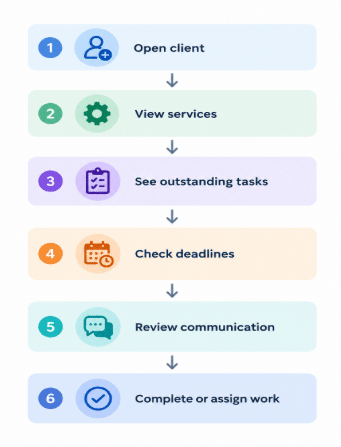
The important point is that staff do not have to reconstruct this information from multiple systems.
How Remindoo Connects Client Management With Tasks
Remindoo is built around the connection between clients and the work carried out for them.
Firms can manage client information alongside tasks, workflows, deadlines and communication. Task and subtask templates can support recurring processes, while trigger dates, reminders and task progress help teams manage work as it moves forward.
Internal task comments also keep updates and discussions connected to the relevant work. This makes client and task management easier and convenient.
This makes Remindoo more than a database of client contacts. It provides a centralised environment for managing the work associated with those client relationships. So, book a demo now!
Key Takeaways
The goal of client and task management is not simply to put more information into one system. It is to create a useful connection between the client, the service and the work required to deliver it.
When those elements are connected, accountants can spend less time asking “Where is that information?” and more time answering the more useful question:
“What needs to happen next for this client?”
For growing accounting practices, that connection can make everyday work easier to organise, track and hand over, without relying on scattered spreadsheets, inboxes and individual memory.
Disclaimer: The information provided in this blog about “How to Connect Client Management With Task Management“ including the text and graphics, in general. It does not intend to disregard any of the professional advice.